 09.01
09.01
Auger Hole Test — Hydraulic Conductivity Test Kit
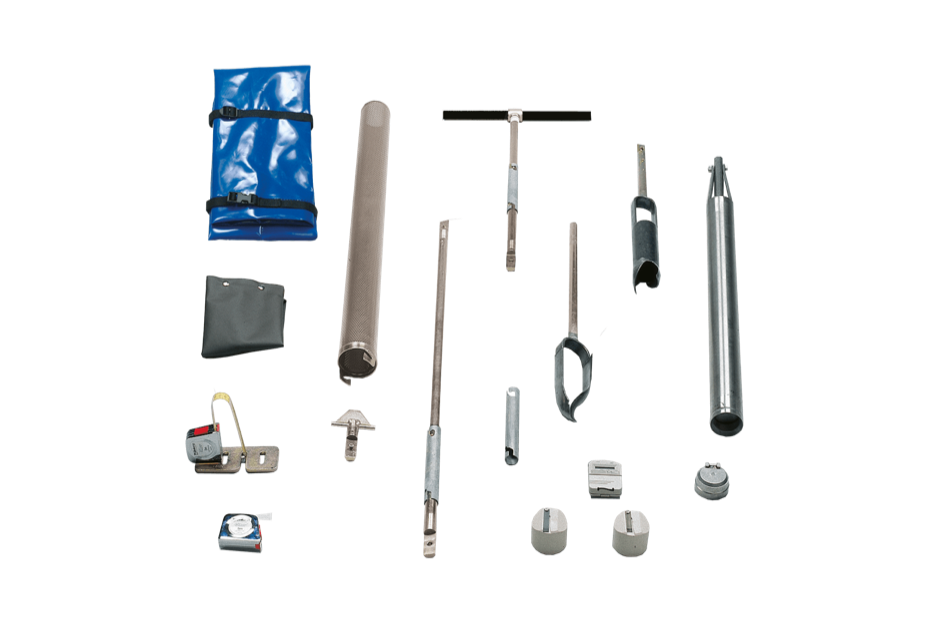
The standard set measures hydraulic conductivity (permeability) to 2 metres depth; the Hooghoudt variant reaches 5 metres. The complete set comes in a field-portable carrying bag.
Method
When measuring the hydraulic conductivity of soil, the auger hole method according to Hooghoudt can be applied for direct measurement in the field. This method determines soil permeability quickly, using a limited number of tools.
The principle is straightforward: a hole is bored into the soil to a given depth below the groundwater table. After some time, the hole fills with water up to that level. This water is then bailed out, and the time taken for the water level to rise again is recorded. Using formulas and/or nomograms, the rate of rise can be converted into an average permeability factor for the soil layers.
The borehole depth depends on the groundwater level and on the thickness and permeability of the successive layers in the soil profile.
Product Variants
| 09.01.SA | Standard set — measurement to 2 metres depth. |
|---|---|
| 09.01.SB | Hooghoudt set — measurement to 5 metres depth. Contains the same parts as the standard set, but the 1-metre filter is replaced with a filter extendable to 5 metres (including auger extension rods). |
Applications
- Infiltration research
- Soil permeability research
Set Contents
- Augers and bailers with extension accessories
- Handled tape measure
- Floats with storage bag
- Stopwatch (with batteries)
- Extendable casing/filters
- Spatula
- Carrying case
| Maximum Measuring Depth | 2 m (standard) / 5 m (Hooghoudt) |
|---|---|
| Reading Accuracy | 1 mm |
| Recording Type | Manual |
| Packaging Size | 117×27×23 cm |
| Weight | 26 kg |
Operation Manual — 09.01.SB Hooghoudt
Manufacturer document (PDF, English)
Installation & Commissioning
Our expert technicians provide on-site installation and initial commissioning.
User Training
We organize hands-on field training for correct and efficient use of the equipment.
Technical Service
Our Ankara-based technical team is ready for repair, maintenance and calibration services.
Spare Parts
We support you with fast supply of consumables and spare parts.